

Discovering the Jura Arc… by Bicycle
Settled on electric bikes from Balsthal to Saignelégier, we imagined this journey as a leisurely ride. After more than 130 kilometers over two days and a night in Saint-Ursanne, our thighs were burning, but the enjoyment remained intact.
“I don’t know of a more accurate way to measure a distance than to cover it with the sweat of your brow.” This sentence from Confidences cubaines by Claude Marthaler—known for his many cycling trips around the globe—echoes in my mind as our train crosses the Röstigraben at the border of Biel/Bienne. Instead of 4,000 kilometers on the revolutionary island, our journey takes us to Balsthal, a village of 6,000 inhabitants nestled in the heart of the Thal Nature Park in the canton of Solothurn.
Balsthal, quite a symbol: from 1933 to 2013, the bicycle manufacturer Mondia, a jewel of Swiss cycling, had its headquarters here. During its heyday in the mid-1980s, 22,000 bicycles were produced each year. Balsthal is also the starting point for many mountain passes in the Jura chain and marks the beginning of stage no. 3 of the “Route Verte,” which links Schaffhausen to Geneva in seven days.
A demanding route
Through the six natural parks of the Jura Arc, this demanding itinerary mainly follows secondary roads. Ruedi Jaisli, one of the twenty-five drivers of the company Eurotrek in Switzerland, welcomes us at the train station. With his Swiss-German accent, he explains the program:
“I created the Route Verte trail using different marked routes from Switzerland by Bike. In addition to hotel reservations and bike rentals, we offer fully customized services for luggage transfer and assistance in case of bad weather or technical problems.”
The adventure begins once we retrieve our electric bikes and fasten our helmets. After a few pedal strokes, we make our first detour to stop briefly along the Holzweg Thal (Woodland Path). Numerous artworks are displayed along a hike leading to a castle whose ruins are still visible. The smell of manure tickles our noses as we head toward the first challenge of the day: the Passwang Pass.


Breathing quickens
The 500 meters of elevation gain immediately set the tone. Climbing a pass on an electric bike is no easy feat. The battery installed under the saddle does not do the work for us—it only provides assistance. The first drops of sweat run down our faces, our thighs warm up, breathing becomes labored. A tunnel signals the arrival at the top of the pass, but the bravest won’t head straight into the descent toward Beinwil Neuhüsli—they will take a turn toward Vogelbergfluh.
Two hundred meters higher, the viewpoint reveals the Alps on one side and the city of Basel on the other. We catch our breath before slipping on a windbreaker. Time for thrills, with a top speed of 59 km/h showing on the odometer. Around us, the first cherry trees are beginning to bloom, while dandelions paint the fields yellow. In the land of clocks, time seems to stop before such a landscape. Only the growling of our stomachs signals that it’s time for a break.


Discovering Switzerland’s youngest capital
In the Schwarzbubenland valley, our water bottle is empty and no drinking fountain can be found along the way. We choose the most natural solution: we knock on the door of a house with a big smile. Then we head for Delémont, encouraged by a “Hop Suisse!” Crossing the historic center of Delémont, Switzerland’s youngest capital, is a pleasure. Its many colorful buildings and fountains dating from the 16th century—like the Virgin Fountain or the Roman Warrior Fountain—give it a certain elegance. But time is short: we set off toward the village of Develier to tackle the second pass of the day, the Col des Rangiers.
To climb a pass, two techniques are possible: standing on the pedals—“en danseuse”—or seated firmly on the saddle with your head close to the handlebars. A matter of preference and style. As fatigue builds, the bike’s battery melts away like snow in the sun. Running out of power in these conditions would be more than problematic, especially since we don’t have a second battery, which is usually provided.
Once at the top, a dilemma arises: attempt the Croix Pass via the birthplace of the famous damassine, a brandy from the Ajoie region—risking running out of strength—or descend directly toward Saint-Ursanne to rest before the next day’s stage. Reason wins quickly, and we head straight to this small village nicknamed “the Pearl of the Jura.”


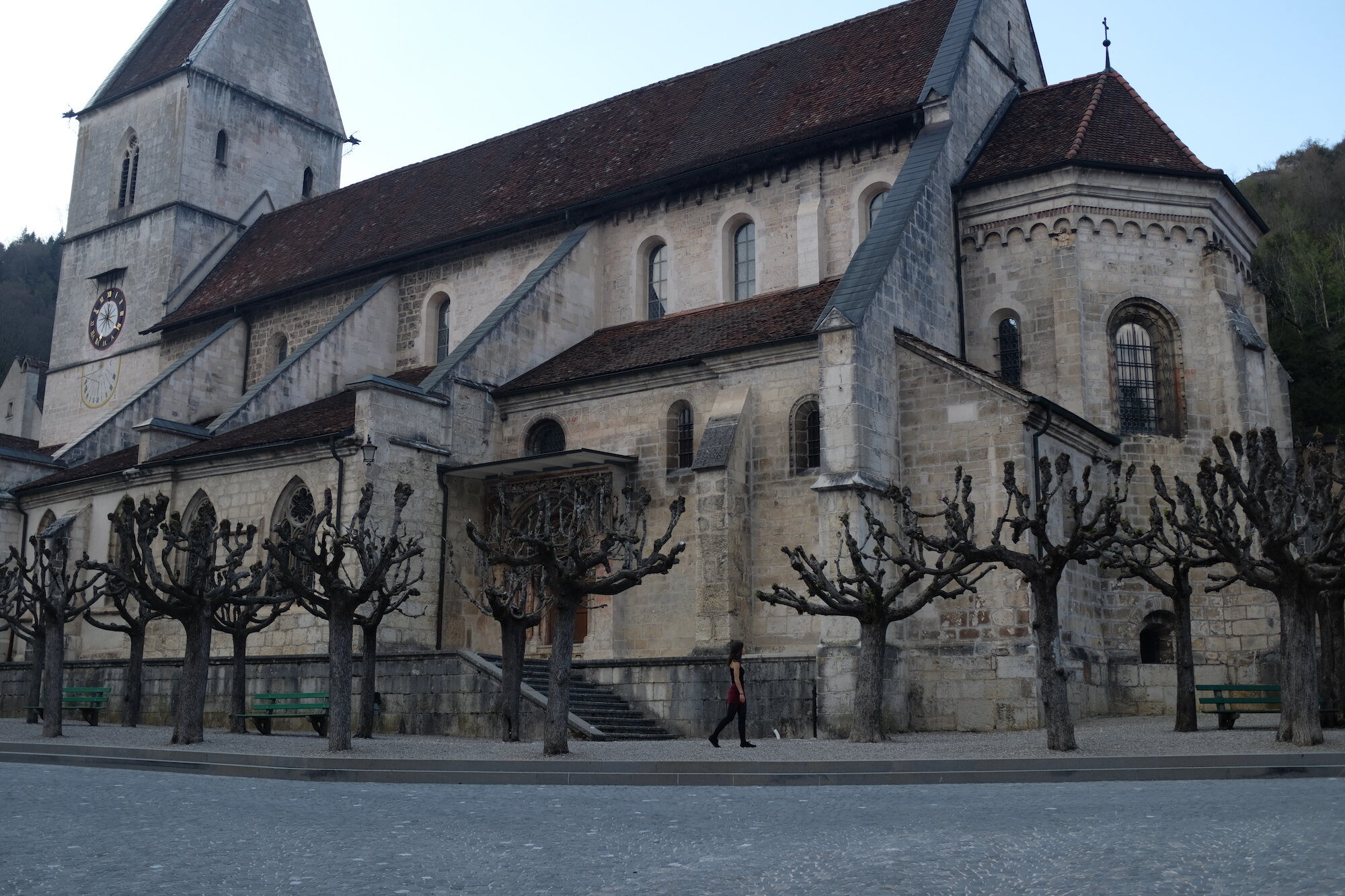

Exploring the “Pearl of the Jura”
Many construction projects are underway in this village of 1,300 inhabitants. Still, this medieval town retains remarkable historical heritage, including the Saint-John Nepomucene Bridge. We stay in one of the nine rooms at the Auberge de la Couronne. Jura hospitality is warm and eager to showcase nature-oriented tourist activities such as canoe treasure hunts or archery. At the table, it is recommended to try the blue or meunière trout, the local specialty.
After a good night’s rest, the next stage promises to be easier. Instead of finishing at Mont-Soleil as planned for stage no. 4 of the Route Verte, we will leave the bikes at the Saignelégier train station. We leave Saint-Ursanne with a light heart, ready to climb the only pass of the day. After spotting a squirrel and some roe deer, we cross the Croix Pass—the one planned for the previous day—and begin the descent with carefree enthusiasm.
But something feels off. No signs for Saignelégier… At the bottom, we check the map on the “Swiss Parks” app. And surprise: we went in the wrong direction. We’ll have to climb the pass again in the other direction to start over once back in Saint-Ursanne. Nothing to discourage us: we retrace our steps while enjoying the landscape from a different angle.


Exploring the region’s riches
Crossing the Doubs valley offers the chance to admire the architecture of centuries-old farms and discover numerous dry-stone walls, a typical signature of the Jura region. Lining the pastures, these walls once served to mark property boundaries, limit deforestation, and help clear stones from the fields.
We pass through hamlets with surprising names: Les Enfers (Hell) contrasts with the serenity of the place, while just a few meters away La Bosse (the Bump) sits in a hollow. We end our journey with a meal at the Étang de la Gruère, a peat bog reminiscent of Scandinavian landscapes, before visiting a breeder of Franches-Montagnes horses. Roaming through wooded pastures, the Franches-Montagnes horse is the only remaining native Swiss horse breed. Farm visits are offered year-round: in the stables during winter, and in the pastures from spring to autumn. Next to the Étang de la Gruère, Ernest Sprunger’s farm currently has twelve horses, a 58-hectare estate, and a new stable built two years ago.

“In our 58-hectare farm, Ernest Sprunger has twelve horses.” © Sébastien Roux
“Even though our main income comes from cows and milk, we have a passion for these horses. The Franches-Montagnes is versatile; it’s suitable for both carriage driving and riding,” Ernest explains during hour-long visits. With his wife Priska and his two children involved in farm work, this passion is handed down from generation to generation. While our bottoms and thighs certainly remember the effort at the end of our journey, the memories gathered along the kilometers are unforgettable.
SÉBASTIEN ROUX
Cover photo caption: Across six Swiss regional natural parks, the Route Verte links Schaffhausen, north of Zurich, to Geneva. © Sébastien Roux

This article appeared in Echo Magazine in May 2019