

“In Concrete Zones, the BioUrban Absorbs Pollutant Gases”
Both based in Puebla, a 2.5-hour drive from Mexico City, the start-ups BiomiTech and CPlantea have developed innovations inspired by natural processes to fight air and water pollution effectively.
Day or night, Mexico City always presents the same face: a sprawling metropolis home to more than 20 million people, where traffic jams never end. Driving through the streets of the capital is a true obstacle course. According to the 2019 TomTom Traffic Index, Mexico City is the 13th most congested city in the world, and the third in the Americas after Bogotá, Colombia, and Lima, Peru. Another telling figure: each year, its residents—known as Chilangos—lose an average of eight days and three hours stuck in traffic.
Photosynthesis vs Pollution
Frequent pollution spikes in this city, surrounded by mountains and perched over 2,000 meters above sea level, are a direct consequence of traffic congestion. In June 2019, an environmental contingency plan was announced by Mexico City mayor Claudia Sheinbaum in order to “face an imminent threat to public health.” Air pollution kills—far more than AIDS, tuberculosis, diabetes, and road accidents combined, according to WHO data. A study published in October 2017 in The Lancet estimates that air pollution causes 6.5 million deaths globally each year.
“Faced with this alarming reality, the government cannot solve everything on its own,” says Jamie Ferrer. “Large companies, start-ups and civil associations also have a role to play.” This Mexican entrepreneur knows what he’s talking about: 18 years ago, he created the company Autotraffic to improve mobility in urban areas through the use of big data. Since 2016, another project has occupied his days: the design and commercialization of the BioUrban, a metallic structure that looks like a tree and contains tubes filled with microalgae.
“With my partner, biologist Carlos Monroy, we needed two years of research and development. The BioUrban is designed to be placed in concrete zones where planting trees is impossible. The microalgae purify the air by absorbing pollutant gases such as carbon monoxide, nitrogen oxides, volatile compounds, and suspended particles (PM 2.5 – PM 10) through the process of photosynthesis.”
The BioUrban Looks Like a Tree and Contains Tubes Filled With Microalgae
The first BioUrban 2.0 is located in Puebla, Mexico’s fourth-largest city. BiomiTech—the start-up behind the BioUrban—chose to set up its offices and laboratory in this city, best known for its countless churches. Installed near a university, the BioUrban 2.0 measures 4 meters high and contains 500 liters of microalgae. “A device equivalent to 368 young trees,” notes Jamie Ferrer, emphasizing that “the BioUrban was not created to replace trees but to complement them in areas where pedestrians and cyclists are the most affected by air pollution.”
A new model is about to launch: the BioUrban 3.0, much larger than its predecessor. In the lab, biologist Juan Jesus Gonzalez is working on the final adjustments with students. The structure looks more like a cylinder inside of which 41 neon-green tubes can be seen. “We’re conducting the last tests to measure the carbon dioxide capture potential of the BioUrban 3.0 compared to the BioUrban 2.0,” explains Jamie Ferrer. To “legitimize” its technology, BiomiTech has partnered with the French group SOCOTEC, specialized in risk management, to obtain national and international certification.
The various awards won across the Americas and Europe since 2018 have helped BiomiTech gain credibility and sell its BioUrban units in cities in Panama, Colombia, and Turkey, in addition to Mexico. “We hope to earn the trust of other cities concerned about air pollution so we can improve the lives of millions of people,” says Jamie Ferrer. A European market entry is scheduled for the third quarter of 2020, even though the German start-up Green City Solutions already offers similar technology in the form of plant walls.
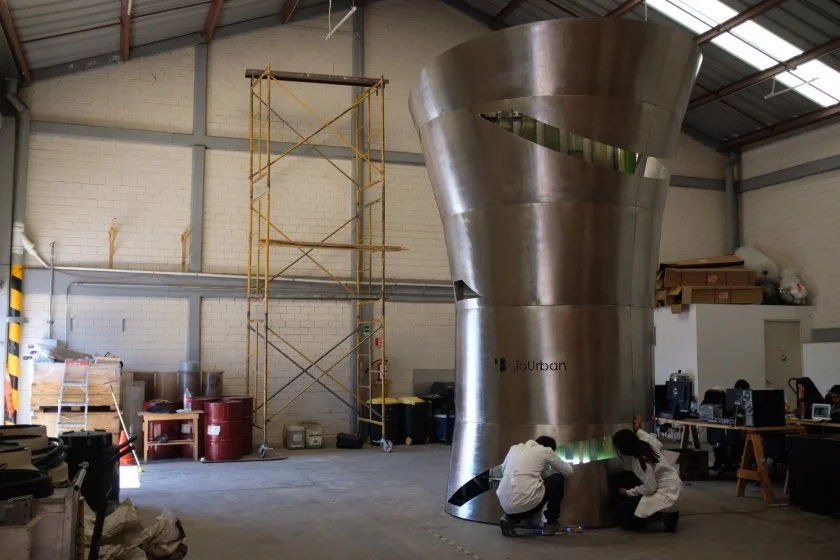
Supervised by biologist Juan Jesus Gonzalez, students are working on the final adjustments to BioUrban 3.0, a structure designed to purify the air in urban areas. © Sébastien Roux
Worms Against Wastewater
Meeting entrepreneurs in Mexico is no small feat. “The start-up world is still in its early stages,” analyzes José Luis Ortiz Robles, co-founder of CPlantae in 2012. “Between 70% and 80% of these companies go bankrupt before their third year,” he adds with a sigh. CPlantae managed to surpass this stage by offering a tank capable of decontaminating polluted water.
Working with biologist Héctor José Garrido Rosales and chemical engineer César Asensy Maldonado Monter, this 31-year-old entrepreneur tested several potential solutions—including one involving elephant dung—before focusing on earthworms and developing the WormPod.
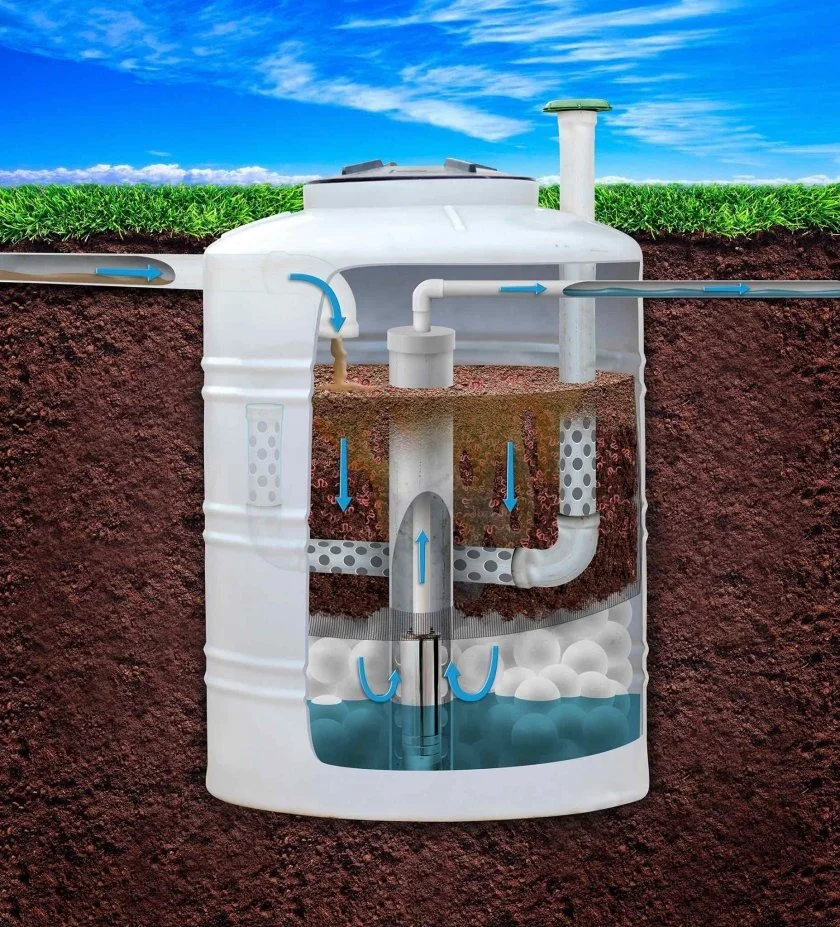
Earthworms are placed in the Wormpod to purify wastewater. ©CPlantea
“We imitate nature and its decomposition process. Earthworms have the ability to purify water without needing external energy,” he explains while presenting the WormPod: a plastic tank filled with gravel and volcanic stones, to which a layer of earthworms is added in contact with the wastewater.
According to the French trade journal Les Cahiers Techniques du Bâtiment, this natural sanitation technique is capable of treating all types of effluents. Another advantage: maintenance is minimal, as the earthworms serve as a filter for four to five years. “This model is easily reproducible,” says José Luis Ortiz Robles. It’s ideal for meeting the needs of a large part of the population, at a time when only 30% of household wastewater is treated, according to Mexico’s National Water Commission (CONAGUA).
The awards won since 2016 and the presentation of its device in Silicon Valley in the fall of 2019 have helped CPlantae establish a strong reputation in Mexico. “Now we want to collaborate more with other start-ups offering green initiatives to truly influence public policies,” says José Luis Ortiz Robles, who views Mexico’s ecological engagement with optimism: “The Mexican population has been increasingly well-informed for nearly a year. We’re moving in the right direction.”
Sébastien Roux
Cover photo credit © Sébastien Roux

This article was published by Usbek & Rica in March 2020.