
Back to summary

Ep 3 - Rise and Fall of Empires
Mexico City feels endless. Where to go? What to do? There are too many possibilities, too many choices—and above all, too many people. I won’t hide it: I’m not a city person. Living in Paris, London, or New York doesn’t particularly inspire me. In this episode, I explore several neighborhoods of the capital before setting off to discover the ancient pre-Hispanic empire of Teotihuacán, as well as Our Lady of Guadalupe.
I. One Last Loop Through the Capital
I wander through the bohemian neighborhoods of Condesa and Roma. A spirit of counterculture hangs in the air, while cracks running through residential buildings serve as a reminder of the recent passage of destructive earthquakes.
Some streets feel cinematic. In 2018, Mexican director Alfonso Cuarón premiered Roma at the Venice Film Festival. Bingo—he walked away with the Golden Lion for this film that sheds light on the daily life of a domestic worker in this neighborhood in the early 1970s.


In search of a bit of calm, I decide to rest in Chapultepec Park. Covering roughly 700 hectares, this haven of peace was named the world’s best urban park in 2019 by the World Urban Parks organization. A meaningless ranking? Maybe. Still, with its 170,000 trees, it is considered the oldest urban park in Latin America and the green lung of an over-polluted city.
Vast natural spaces intimidate me less than vast concrete ones. I quickly find my bearings in this enormous park. Along the fences surrounding the Casa del Lago Juan José Arreola, I walk past a series of posters bearing powerful symbols.


“No to war,” reads one of them, using Coca-Cola’s visual identity. Dated 2003, its creator denounces the war in Iraq as well as the interference of multinational corporations in Indigenous cultures. “Global warming,” warns another, depicting a man who looks like a glacier struggling to breathe. Created in 2009, the artist Andrès Mario Ramirez Cuevas calls for greater care of our environment, particularly in light of rising sea levels and the increase in natural disasters.
I decide to visit the Casa del Lago. Upon entering this cultural venue, I discover a photography exhibition dedicated to recent migration across the American continent. While European media often focus on African migration, the issue is just as pressing across the Atlantic, with population movements in Central America and Venezuela—driven by the same hope: to live in a better world.
I think back to a film that deeply affected me when I was younger: Sin Nombre. Sayra, a young woman from Honduras, dreams of emigrating to the United States. Casper, a former member of a violent gang—the Mara—must flee after killing his gang leader. They meet on the roof of a train, the infamous “La Bestia.”

The entrance to Mexico City’s National Museum of Anthropology looks like a flying saucer. © DR
Mexico City is overflowing with cultural venues. The capital ranks among the top three cities with the most museums. The competition is fierce between Paris, New York, and Mexico City. In total, the Mexican capital boasts more than 160 museums. I spend five hours at the National Museum of Anthropology. To truly take in the diversity of the works—sculptures, textiles, jewelry, ceramics—I would have needed three days. A journey through time, encountering the Maya, the Aztec, the Zapotec, and the Mixtec civilizations.
© Sébastien Roux
II. The Fall of Teotihuacán
Before heading to the state of Puebla for a report, I travel to Teotihuacán, a renowned pre-Hispanic empire. The site is shrouded in mystery. Archaeologists continue to excavate in an effort to unravel the many secrets of this city. Very little is known about the builders who laid its first stones around 200 BCE, just as we remain unsure why the city collapsed some 900 years later. One hypothesis suggests an internal collapse caused by a deeply unequal social structure.
What we do know is that the Aztecs arrived after the disappearance of the original builders and more or less said, “Alright, we’ll settle here.” They named it Teotihuacán: “the City of the Gods” or “the place where men became gods,” depending on the translation. No pressure. Digging so as not to forget. Digging to question. If retracing history serves as a compass, it is up to us to know how to read it—so as not to repeat the same mistakes, endlessly.
To get to Teotihuacán, I choose public transportation. It’s not about saving a few euros so much as embracing a spirit of self-reliance: finding the right bus, talking to the driver to make sure I’m not heading in the wrong direction (my sense of direction isn’t always foolproof). We leave the city to the sound of “Quizás, quizás, quizás,” sung by a performer covering a world-famous Cuban song. Singing is common on public transportation in Mexico—anonymous artists offer moments of shared experience over a few kilometers.
At a red light, clowns catch my attention with a series of acrobatics. Singers, clowns—informal labor is commonplace in this country as a way to earn a few coins. Over the course of my journey, I notice that Mexicans are often more generous than tourists. They may have less to give, but they give anyway.
On the bus, I strike up a conversation with Riquelme, a young Chilean woman finishing her trip the next day. She has traveled across part of Mexico starting from the Yucatán Peninsula, famous for its dream beaches. “The tourist influx in that state has its downsides,” she tells me. “Many travelers act like kings, caring more about their image on social media than about the beauty of the places and the magic of human connections…” Will it be the same at Teotihuacán?
After about an hour, we arrive around 11 a.m. The most motivated visitors came early to enjoy the site almost alone. Hot-air balloons floating through the dawn sky add a poetic dimension. Something to consider next time!
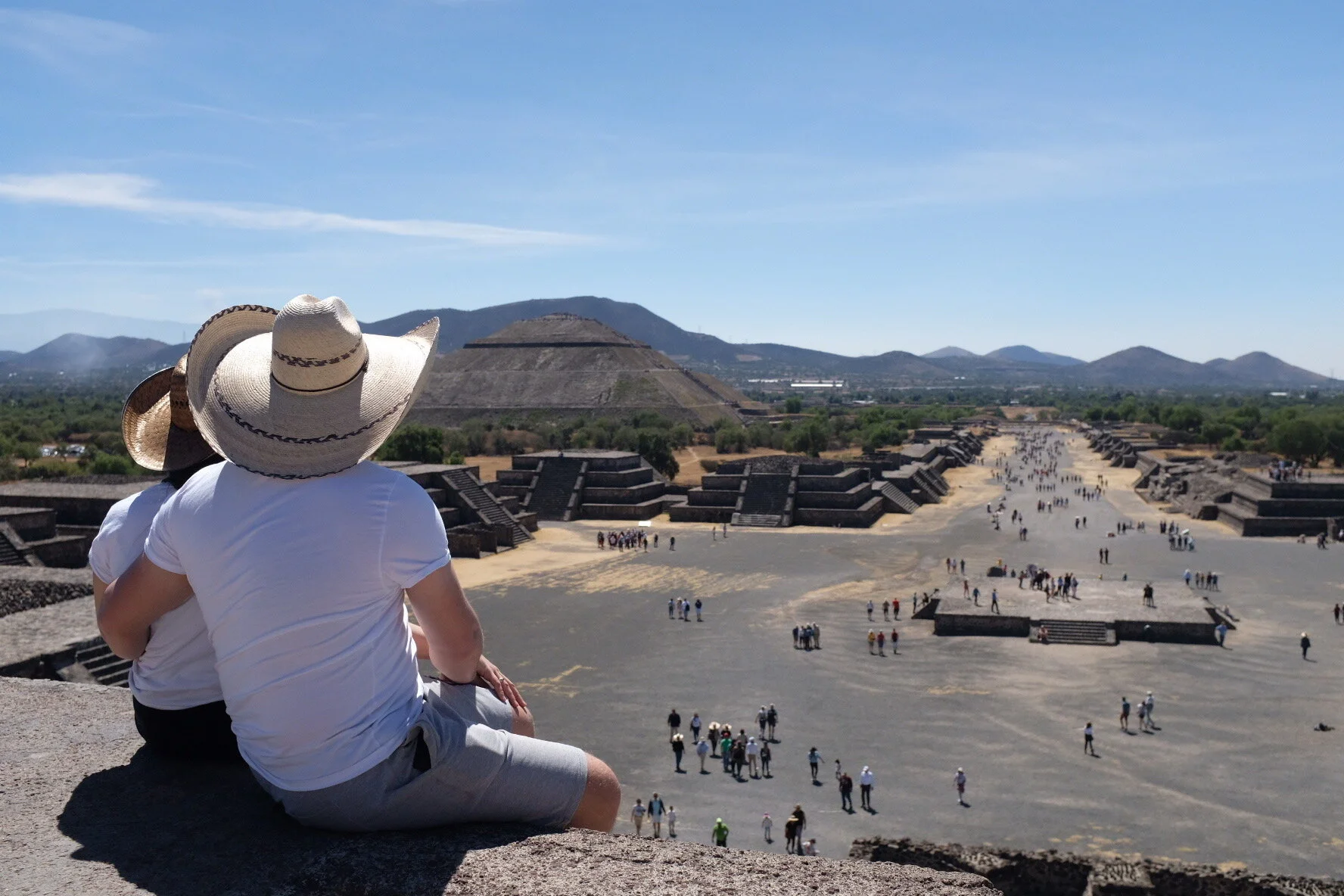
By 11 a.m., the balloons are gone, but the blazing sun is not. Teotihuacán offers no respite: shade is scarce, water is essential, and the heat is stifling. Before us stands the Pyramid of the Sun—the oldest, the most impressive. Does it resemble an Egyptian pyramid? Not really. This one ends in a wide flat platform where fire rituals once took place. To reach its 65-meter height, visitors climb step by step—238 steps in total.
It’s a crush, everyone moving single file. People breathe heavily; some wear masks—probably coronavirus paranoia (as noted in my travel journal at the time…).
At the top, everyone wants their photo, preferably looking alone in the world. I observe various poses: back to the camera, gazing at the horizon like a modern-day explorer; sitting down, arms braced to suggest intense effort followed by contemplation; arms raised in triumph, eyes locked on the lens to display determination.
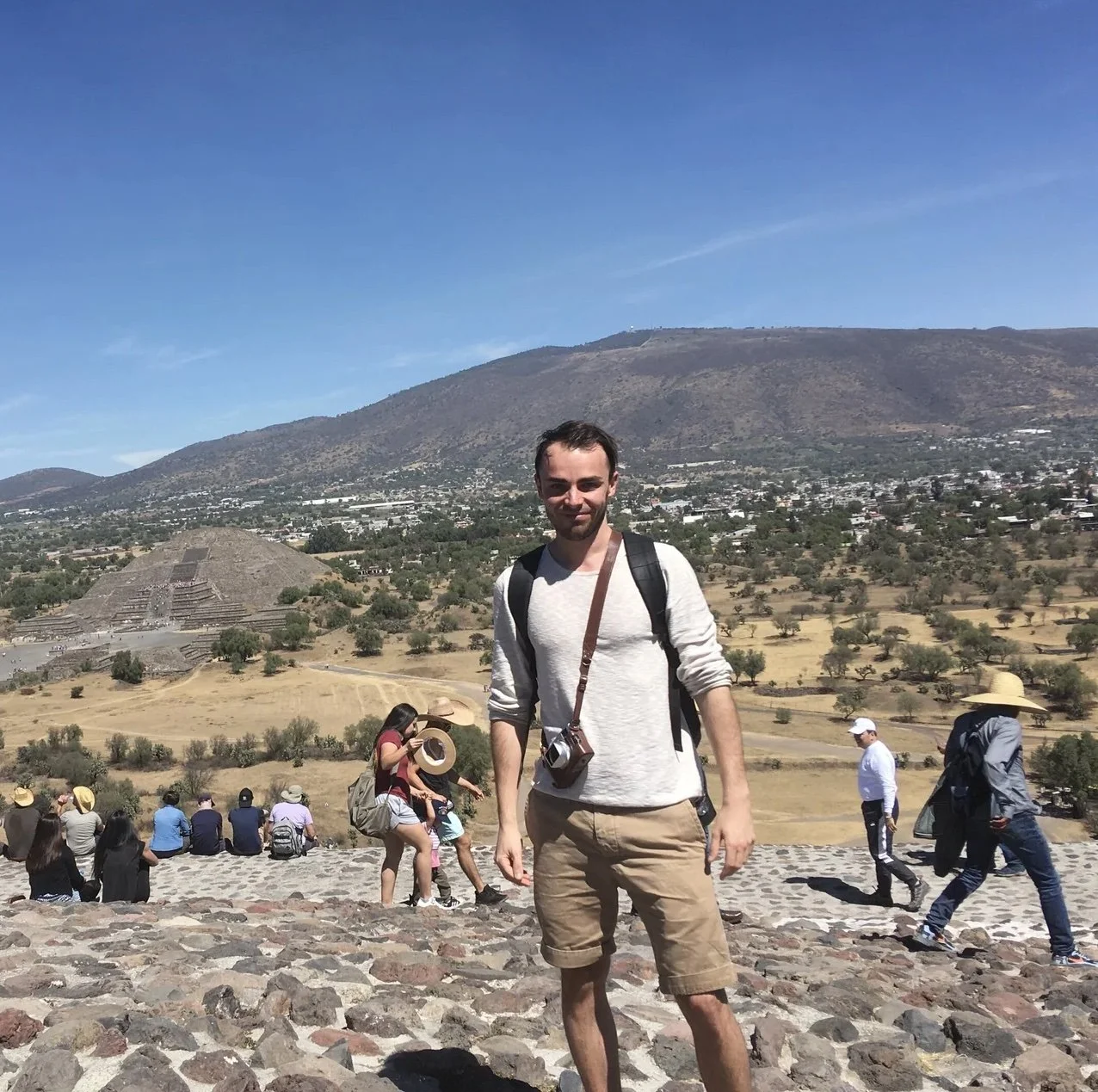
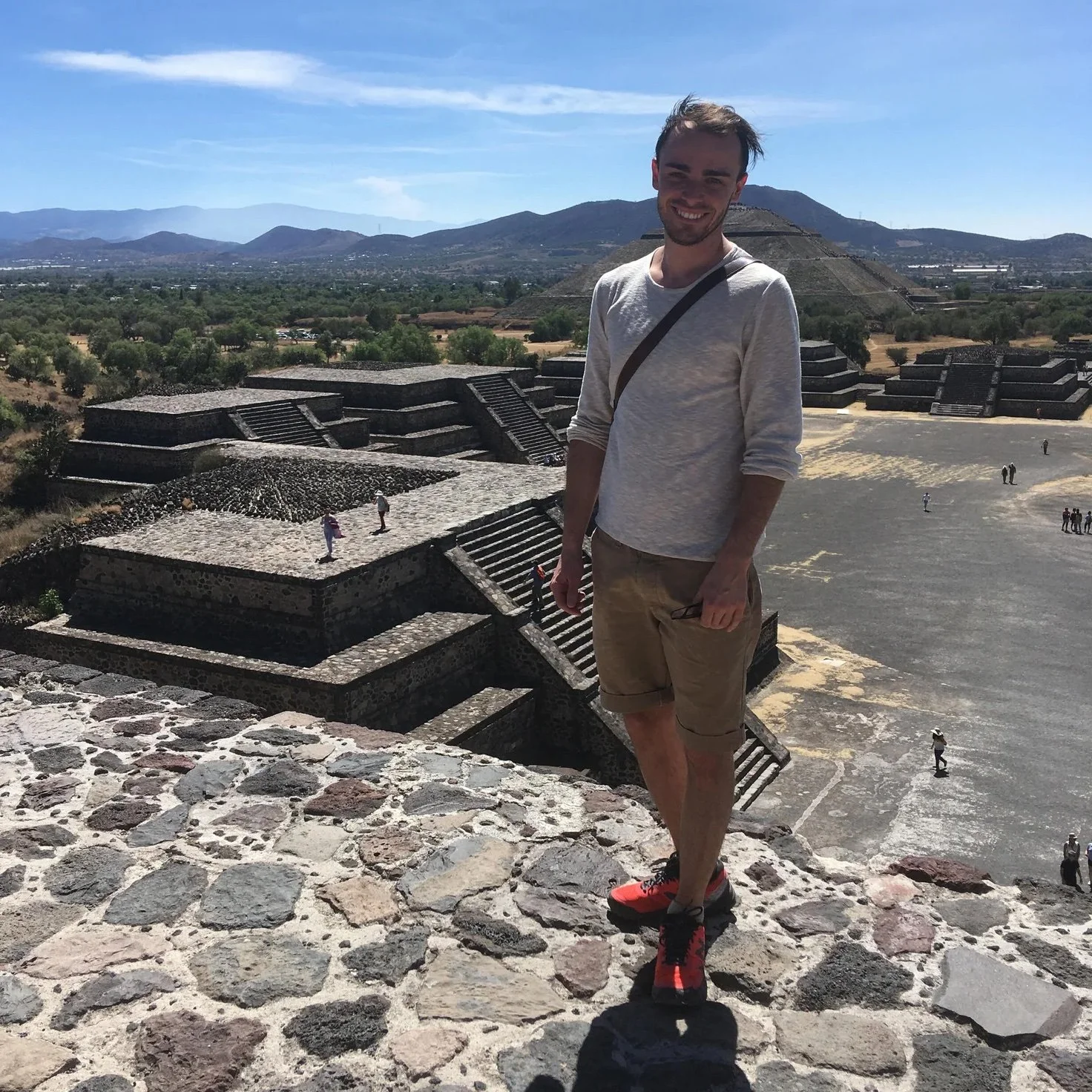
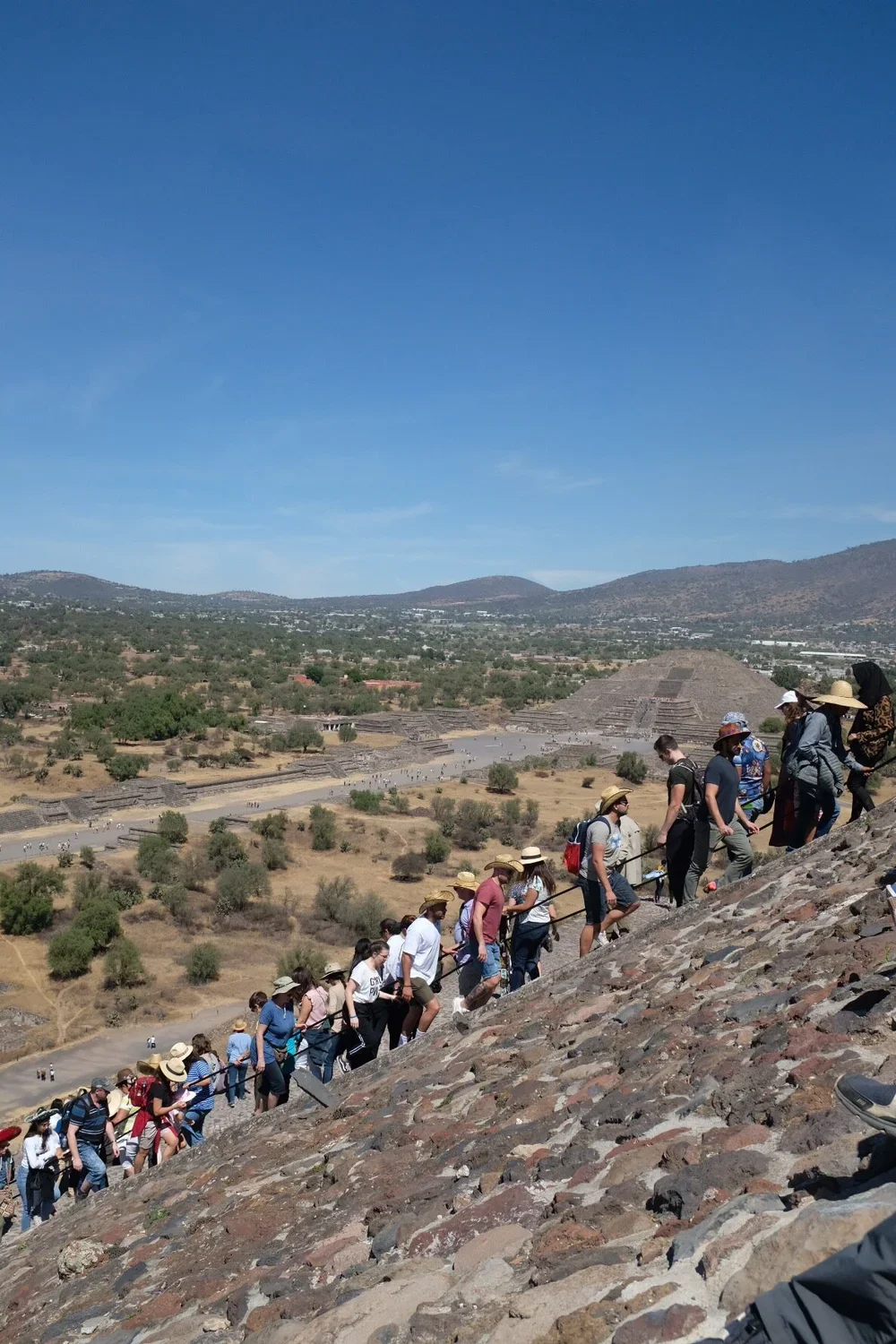
I’m no exception. After all, we all want to leave with a trace of our passage. I pose in front of the Pyramid of the Moon, my camera slung over my shoulder. Deep down, I think about the titanic manual labor required to build this city, which may have housed between 100,000 and 200,000 inhabitants at its peak. On the way down, watch your step—it would be foolish (and painful) to tumble all the way down.
Once back at ground level, the Avenue of the Dead stretches out to my right—a gathering place between the two most important pyramids, the Sun and the Moon. Their placement is anything but random: they align with the sun twice a year during the solstices.
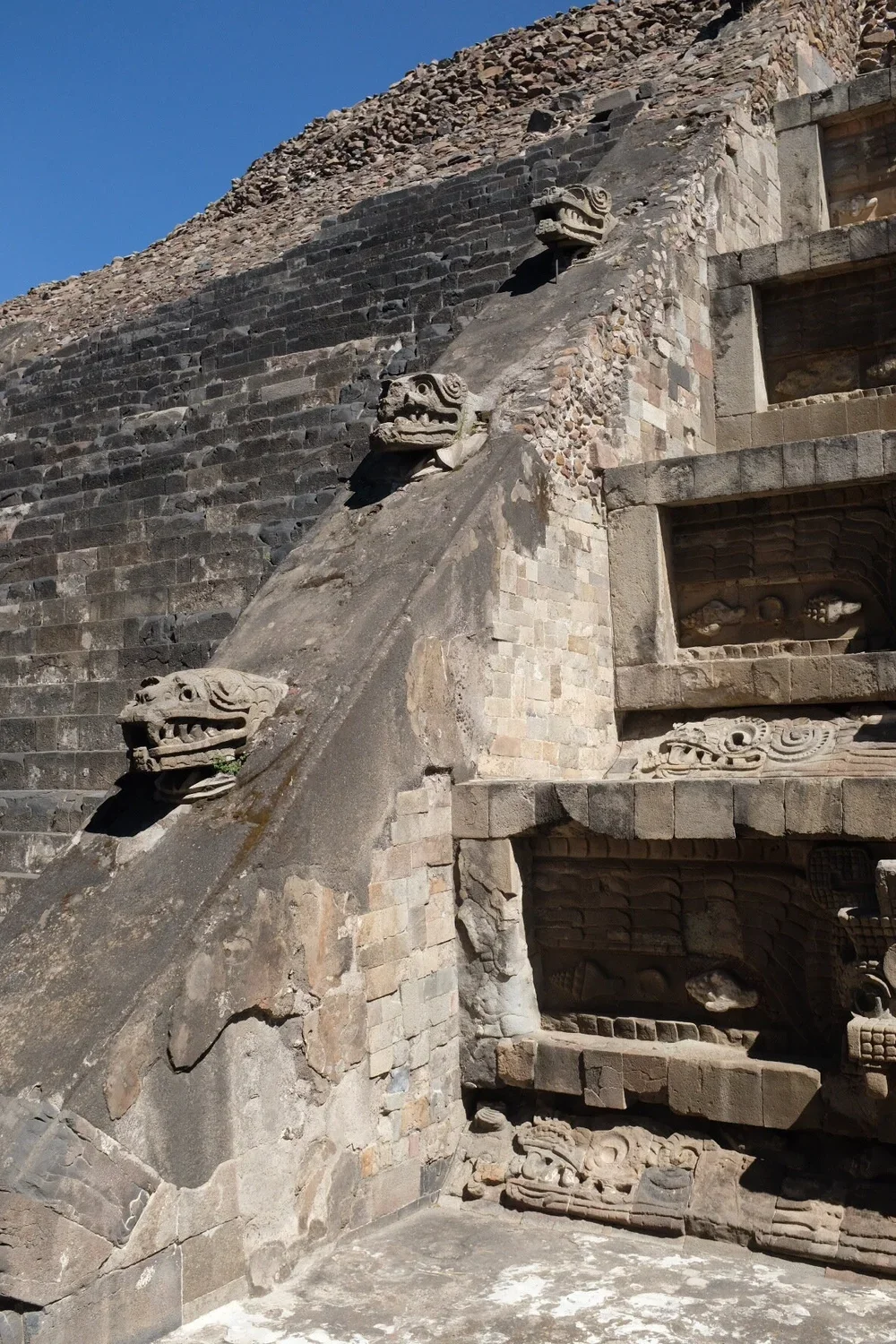
A fascinating spectacle that draws thousands of people here—or to Chichén Itzá, a Maya site in the Yucatán Peninsula, considered one of the Seven Wonders of the Modern World. Though smaller, the Pyramid of the Moon has steeper, narrower steps. The effort is worth it: from the top, the view over the site is unobstructed. In the distance stands the Temple of the Feathered Serpent, regarded as the creator god by many Mesoamerican civilizations.

© Gaspar Hernandez
III. In the Footsteps of Our Lady of Guadalupe
After exploring parts of Mexico City and visiting Teotihuacán with Riquelme, we board the bus back to the capital. It’s packed; I stand for part of the ride—it’s all part of the adventure. Looking at a map, I notice another “must-see” located near the bus terminal.
It’s the Basilica of Our Lady of Guadalupe, a church with a modern, almost futuristic look, rebuilt in 1976 by the eccentric Mexican architect Pedro Ramírez Vázquez. The old walls were on the verge of collapse.
Inside, the basilica can hold 10,000 people. That number rises to 100,000 during major events, thanks to the use of the atrium, the esplanade in front of the church, and surrounding buildings. A very different architecture from Teotihuacán, yet a similar ambition. I am clearly standing in one of the strongholds of Catholicism. Worshippers crowd in to see the image of the Virgin of Guadalupe, one of the most important figures of Catholicism in Latin America. According to tradition, she appeared in 1531, brought by Spanish conquistadors and evangelizers.

© Drkgk
A mystery surrounds the Virgin’s eyes. Thirteen human figures are said to be visible in her pupils. The fascination is such that some pilgrims cross the city on their knees to prove their faith, finishing this multi-kilometer ordeal bleeding…
Inside, the original image of the Virgin enjoys a popularity comparable to the Mona Lisa at the Louvre. The space is tight, people push to catch a glimpse. To prevent bottlenecks, a solution has been found: two moving walkways. An unusual idea—for a church.
Believers come here to reflect, cry, pray, to fully submit to this religious authority. There is something fascinating about it, but also something terrifying. Is it our fears that drive us to believe in the afterlife? Or is it the power of buildings, saints, and promises that seduce millions of people?
I don’t pretend to have answers to these questions. I truly don’t know. I respect religions, but I prefer to distance myself from them—probably a matter of upbringing. Still, this place has a special energy: it is the second most visited Catholic site in the world, after Vatican City. And the site is not limited to the basilica alone—it is a true religious Disneyland.

© Juan Carlos Fonseca Mata
The Marian sanctuary of Our Lady of Guadalupe includes several buildings: the basilica, of course, but also the Capuchin convent and its church, as well as the Templo Expiatorio a Cristo Rey. The latter is noticeably sinking on one side. The reason? The city is built on a former lakebed. The ground shifts, the earth trembles, and people fear. The 1985 earthquake is still vivid in collective memory: 10,000 dead, more than 30,000 injured, and a fragile city.
Is this the symbol of a declining religion? Or a future Leaning Tower of Pisa that will attract new tourists? Over five centuries, Mexico has undeniably been evangelized. Yet according to recent estimates, 80% of the population was Catholic in 2010, compared to 90% in 1990. It’s time for us to move on. The state of Puebla is calling.
Sébastien Roux
Cover photo © Cinthia Aguilar